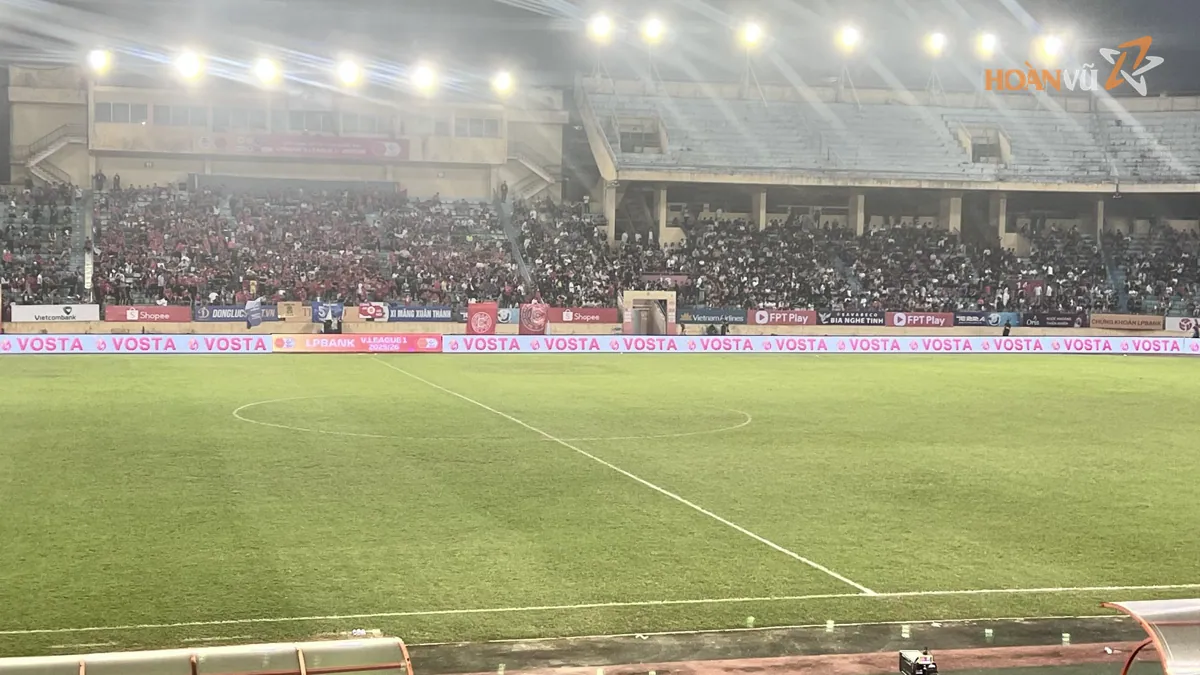
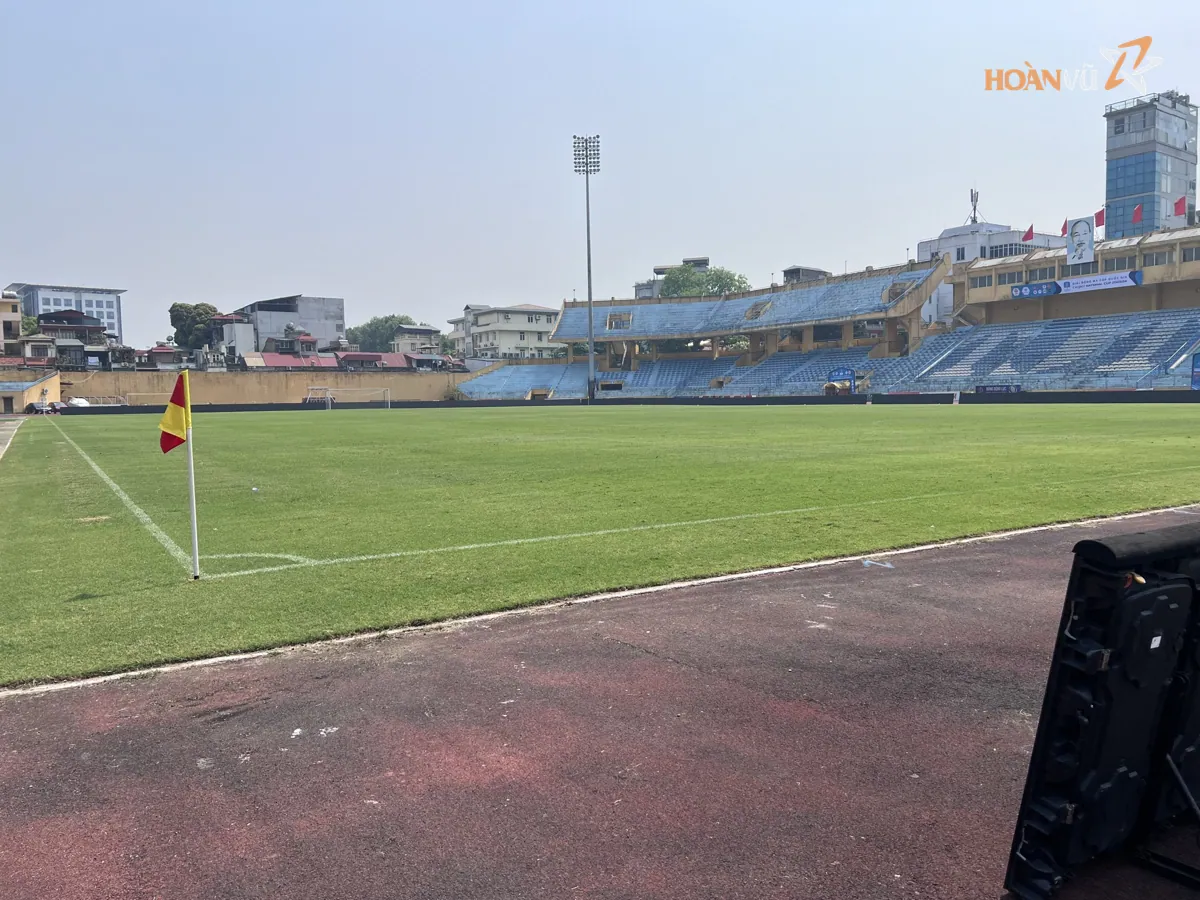
Before kick-off, the match commissioner walks the touchline and looks at one thing: the gap between the perimeter LED and the painted line. That gap decides whether the boards stay where they are or get pulled back. For a club or a brand, a misplaced perimeter LED line is not only paperwork. Players run close to the touchline, the assistant referee moves along it, and a slide into the edge of a board is a real risk.
What the Laws require
Law 1 of the IFAB Laws of the Game, section 1.12, permits no advertising on the field of play, on the ground inside the area enclosed by the goal nets, in the technical area, in the referee review area, or on the ground within 1 m of the boundary lines, for the whole time the teams are on the field. The Laws also forbid advertising, or any attached equipment such as cameras and microphones, on the goals, nets, flagposts and their flags.
The Law 1 question-and-answer page of the Vietnam Football Federation answers the question that comes up most often, whether the 1 m rule also binds boards behind the goal line. It does: every advertising board must be at least 1 m from the boundary lines of the field.
| Item | Minimum requirement | Source |
|---|---|---|
| Ground-level advertising from the boundary lines | 1 m | IFAB Law 1.12 |
| Upright boards from the touchlines and the goal net | 1 m | IFAB Law 1.12 |
| Upright boards from the goal line | equal to goal net depth | IFAB Law 1.12 |
| Boards behind the goal line | 1 m from the boundary lines | VFF Law 1 Q&A |
Layout and board count: the club's preparation
Board placement is not a free choice. The 2023 National Cup regulations set the official board count at 2 competition-name boards plus 40 boards for the home club, split across the stands, sitting tight against each other to the official layout drawing.
Responsibility is as clear. The club pays for, produces, installs, uses and maintains the advertising items to the size, template, quantity and layout set by VPF, replaces boards before the second phase of the season, and replaces any board that is dirty, faded or damaged. VPF supplies the layout drawing, sizes, sponsor logo templates and the file needed for advertising permits, and electronic boards must follow VPF guidance. In practice the layout and the permit paperwork come before any talk of brightness.
How perimeter LED cabinets are built to soften impact
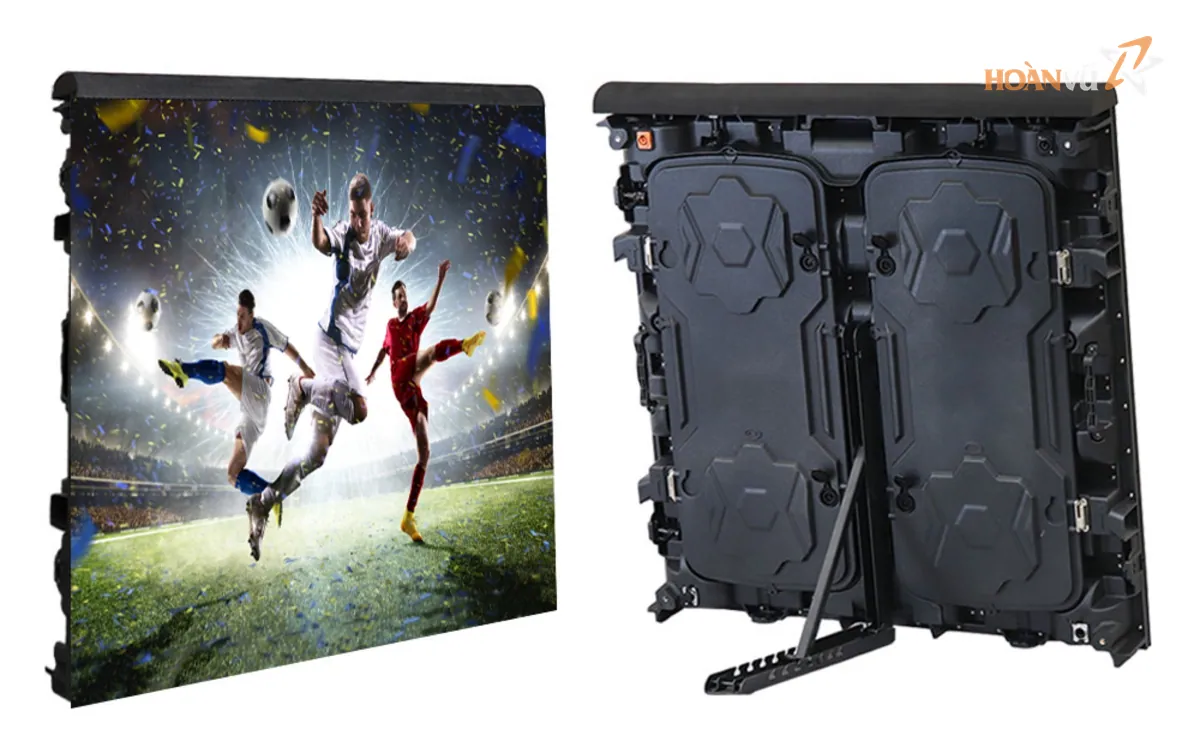
A perimeter LED line sits where players can arrive at speed, so the hardware differs from an ordinary LED screen. Technical material for the Peri Pro perimeter series from manufacturer YUCHIP lists a cabinet of 1600 x 900 mm, 98 mm thick, 45 kg per panel, IP65 front and rear, brightness of 6,500 to 7,000 cd/m2, a 3,840 Hz refresh rate, a soft front mask, a removable protective cushion on top and a support bracket adjustable through 6 angle settings. Material from manufacturer Linsn likewise describes a soft rubber mask on the cabinet front and on each module, with cushioning, an IP65 housing and rear brackets adjustable from 0 to 90 degrees.
Those three details matter more than appearance. A soft front turns part of the impact into deformation of the rubber layer instead of loading it all onto the player. A top cushion covers the upper edge, the part most likely to cause injury in a slide. An angle-adjustable bracket lets the line lean slightly outward, which helps the camera read the board face and turns a collision into a push outward rather than a hard stop.
Where boards are most often placed wrong
- Technical area and benches: Law 1 forbids ground advertising inside the technical area, so a board line crossing it has to stop at the right point and leave coaching and medical access clear.
- Behind the goal: the distance follows the depth of the net, not an estimate.
- Corners: the corner flagpost is at least 1.5 m high and the corner arc has a 1 m radius, and nothing may be attached to the flagpost, so the corner section has to leave room for a corner kick.
- Grounds without a running track: a stadium with a track usually has room for boards and power cabinets. Without one, the space between the line and the stand is tight and has to be measured before the layout is fixed.
Cabling, fixing and the pre-match acceptance
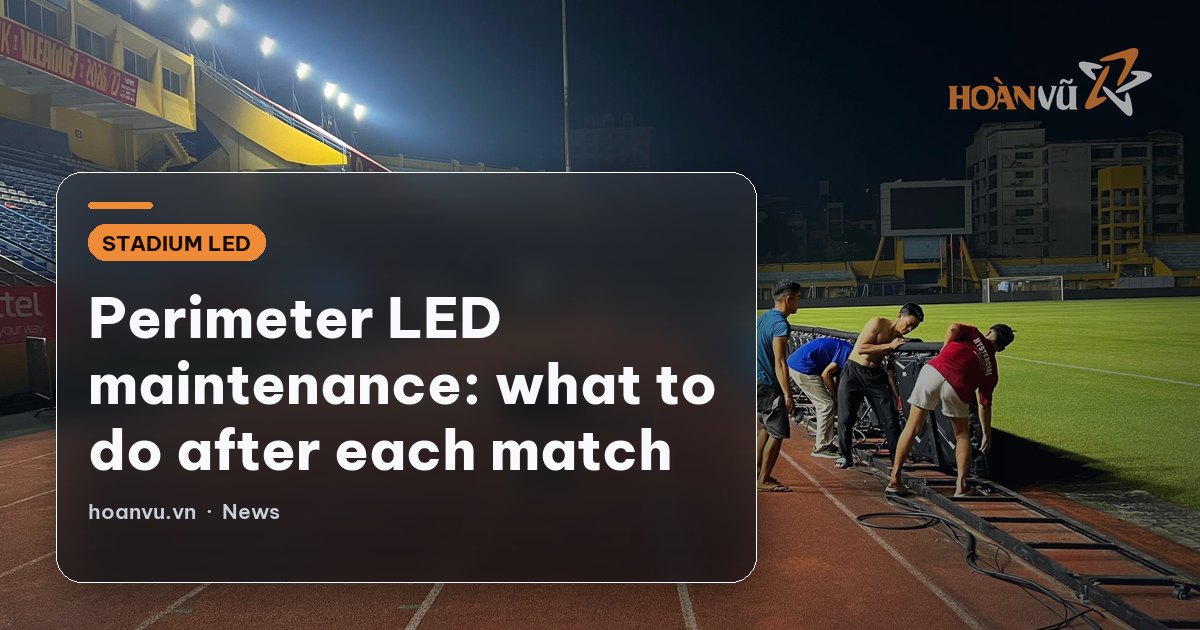
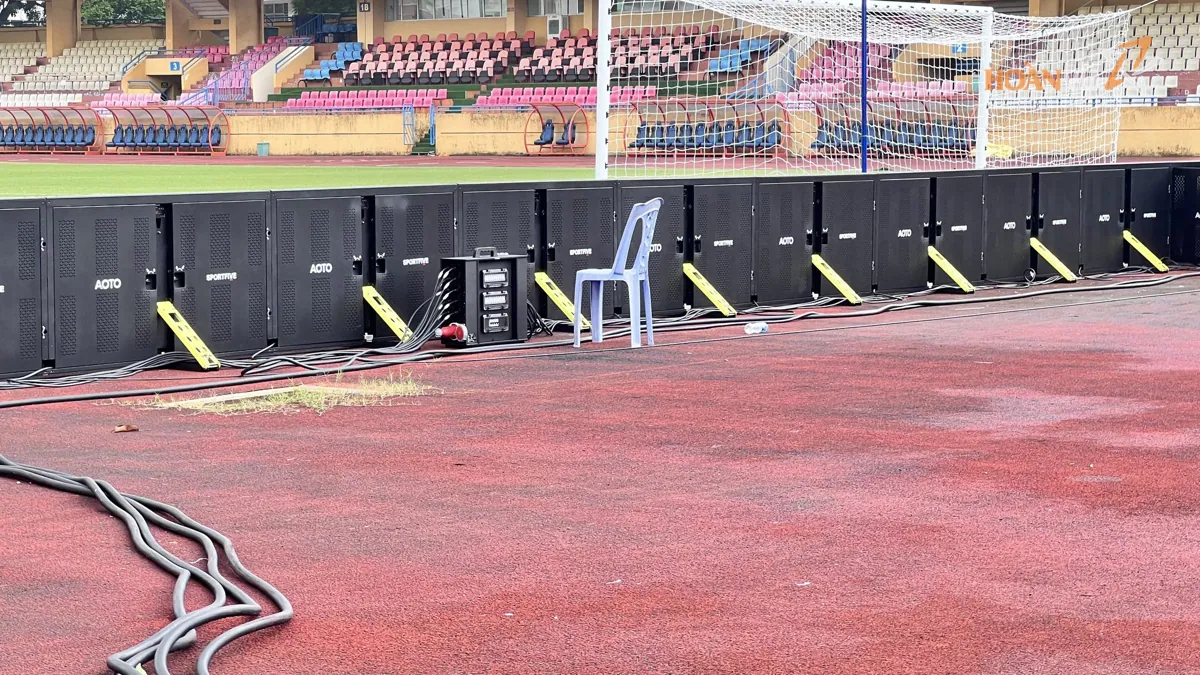
The rear of a perimeter line carries power supplies, power and data cables and connectors. Manufacturer material cites waterproof connectors, a quick-lock system and dual backup for both power and signal. The on-site work matters as much: cables run along the foot of the boards and bundled, never across the players' route onto the pitch or a stretcher path, and mobile power cabinets kept outside the running zone.
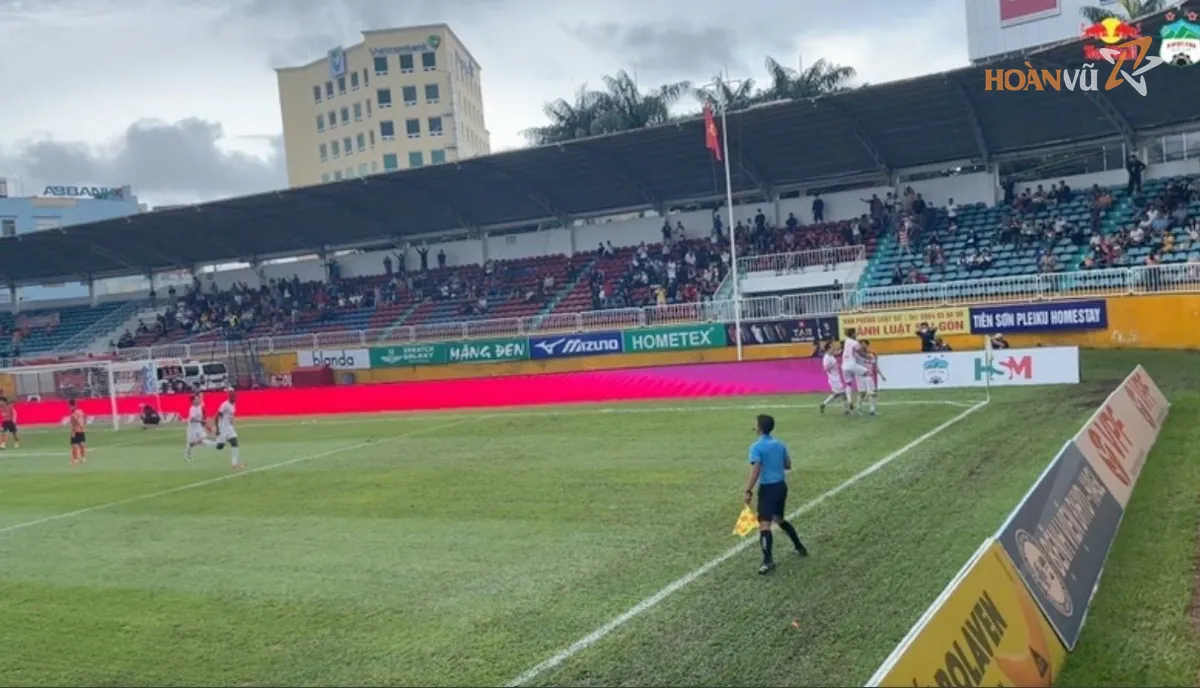
Hoan Vu has worked in advertising since 2001 and was incorporated as a joint stock company in 2010. It operates perimeter LED at 4 grounds, Hang Day, Lach Tray, Binh Phuoc and Pleiku, alongside 6 clubs and around 84 matches a season. A technical crew runs the system at every match, and an acceptance record with photos and video lets the club and the sponsor check the delivery afterwards. The detail on IP rating and power is in Stadium perimeter LED: IP rating, power and lightning.
What to check before and during the match
Six checks worth making routine:
- Re-measure the distance from board edge to painted line on both touchline and goal line, against the organiser's layout.
- Check every support bracket is locked and the lean angle is even along the whole line.
- Inspect the soft masks and top cushions, and replace any piece that is loose or cracked.
- Load-test the power and run a per-cabinet colour check.
- Tidy the cabling and fix the sections crossing the pitch access and stretcher route.
- During the match, keep a crew member watching the line so a cabinet knocked out of place in a challenge near the touchline can be reset.
Frequently asked questions
How far from the touchline must a perimeter LED board sit?
IFAB Law 1.12 sets a minimum of 1 m from the boundary lines, and for upright boards 1 m from the touchlines and 1 m from the goal net. The distance from the goal line equals the depth of the goal net.
Does a soft mask reduce image quality?
The soft mask is a cover in front of the module that absorbs impact and blocks stray light. Image performance comes from the module and the processor, which is why perimeter cabinets still publish brightness and refresh figures at broadcast level.
Who is responsible for installing the boards, the club or the sponsor?
Under the competition regulations the club pays for, produces, installs, uses and maintains the advertising items to the layout and sizes set by VPF, including replacing damaged boards.
Conclusion
Safety on a perimeter LED line is three layers together: distances that follow the Laws, cabinets with a soft face and solid brackets, and a crew that checks before every match. A club or brand preparing a line for the season can look at stadium LED solutions or leave your details. Hotline 0964 73 74 73.
Hoan Vu designs, installs and runs match-day LED, with co-investment options.