Brands that want to show up at a football ground keep asking the same question: buy printed perimeter boards fixed in place all season, or buy match-day LED advertising. From the stand the two look alike. The way airtime is counted, the way creative is approved and the way results are measured are not alike at all. Pick the wrong one and the budget still goes out, with nothing solid to present at season end.
This piece compares them on the things that decide it: league rules, board placement, broadcast specs and how exposure gets counted.
How printed boards and perimeter LED differ
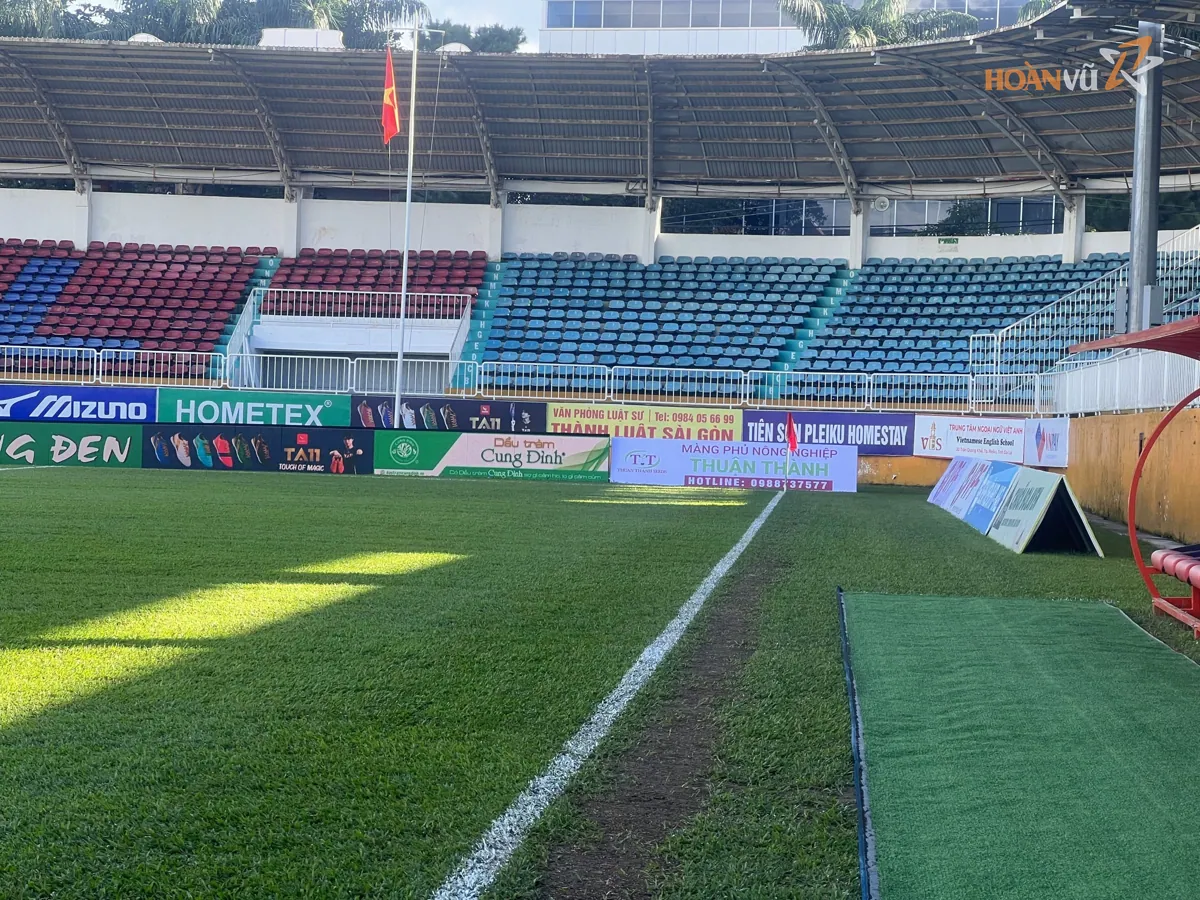
A printed board is artwork mounted in a frame around the pitch. The 2026/27 National First Division regulations issued by VPF are specific: phase-one boards are double-sided, 1 m high and 5 m long; phase-two boards are single-sided at the same size. Board counts are allocated per stand A, B, C and D, to the competition name, to the home club and to VPF.
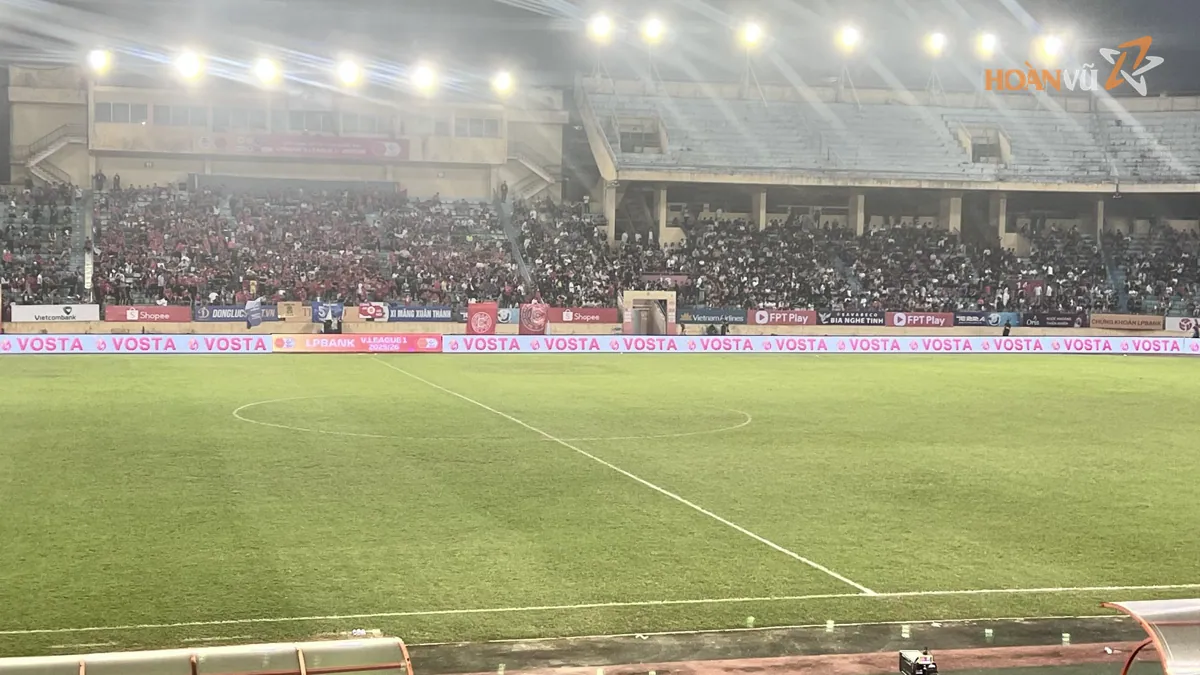
Perimeter LED is an electronic strip in the same position. Under the same regulations, electronic boards may replace framed boards, and airtime is calculated from the official board count and spread across the 90 minutes. Put simply: printed boards sell space, perimeter LED sells time.
Quick comparison
| Criterion | Printed boards | Match-day perimeter LED |
|---|---|---|
| Unit sold | A fixed board position | Airtime split across 90 minutes |
| Changing creative | Reprint and remount | Swap the file, boards stay up |
| Multiple brands | One brand per board | Several brands rotate on one strip |
| Motion content | No | Yes, moving text and graphics |
| On-site crew | Install and strike | Crew on duty through the match |
| Running cost | Low | Higher, needs power and a crew |
| Acceptance data | Condition photos | Play logs plus per-match photo and video |
League rules to read before signing
Three points get skipped most often.
- Advertising rights sit inside the competition's commercial rights. The Vietnam Football Federation professional football regulations, as amended in 2023, place advertising rights within commercial rights, and the competition organiser holds the right to exploit sponsorship, advertising and broadcast rights. A brand buying through a club uses the club's share of boards.
- The priority product category. The regulations give the competition's main advertiser priority in one product category. A club may only sell advertising in categories that do not compete with it.
- Extra inventory must be declared. A club may sell further advertising inside the stadium, provided it notifies the organiser, submits designs and follows instructions.
Board placement and safety
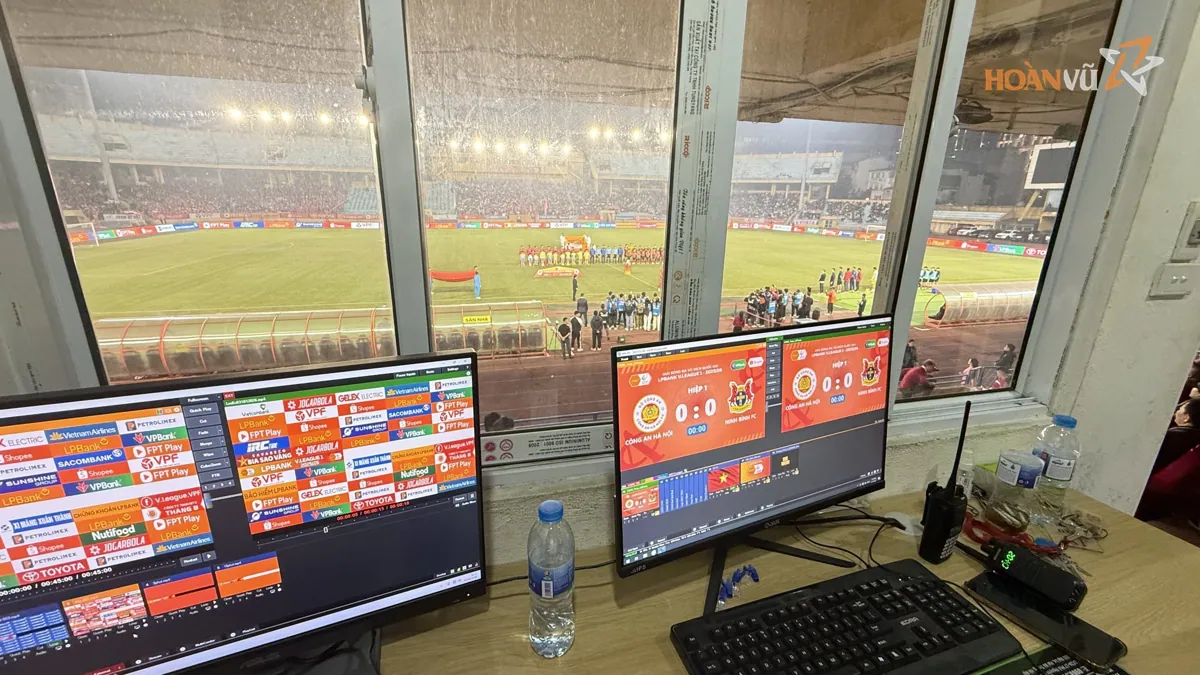
The FIFA football stadiums guidelines set clearances for the board line. At minimum there should be 2 m of level surface beyond each boundary line. In larger stadiums, boards sit beyond 5 m from the goal line and 4 m from the touchline; in smaller stadiums the figures are 4 m and 3 m. Any slope beyond the first two metres should not exceed 5 degrees.
The safety side is equally clear: boards must not block spectator sightlines, must be collapsible or carry emergency access points aligned with evacuation routes, and must not sit over pitch sprinklers. For LED specifically, FIFA notes an active screen height of about 0.9 m with an overall unit height of about 1.0 m, and a redundant power supply so the image does not drop mid-match.
These numbers decide how many metres of LED a given ground can actually take. A site survey is not an optional step.
What specs actually read well on camera
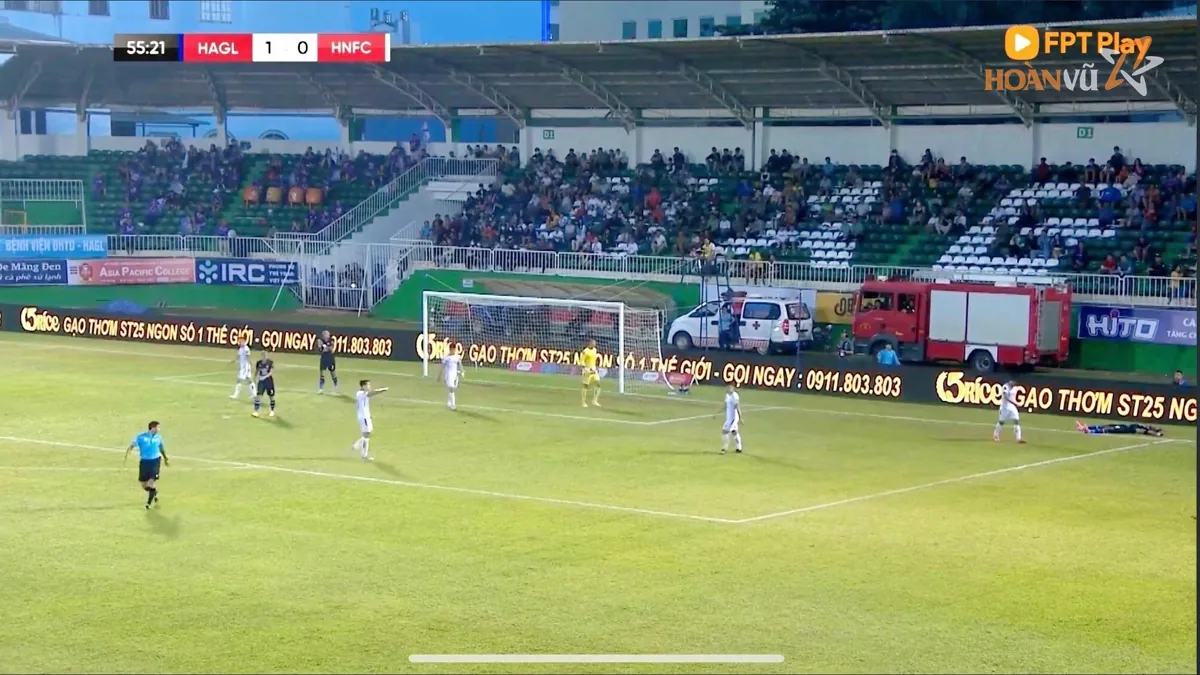
If the LED strip looks banded or smeared on the broadcast, most of the value is gone. Technical documentation from perimeter LED manufacturers cites a few common marks:
- Pixel pitch P8 to P10 for outdoor football; P6 where seating sits close to the pitch.
- Brightness from 5,000 nits upward for outdoor use.
- A refresh rate of 3,840 Hz as the stated minimum for broadcast capture.
- Cabinets commonly 960 x 960 mm, rated IP65 for outdoor use.
- A soft rubber front mask and rounded edges to reduce player impact risk.
When pricing a perimeter LED package, ask for four numbers in writing: pixel pitch, brightness, refresh rate and ingress rating. A missing refresh rate is the one that matters most to a broadcast camera.
Measuring results: what to count
With printed boards the data is usually a set of condition photos. Perimeter LED gives more to count.
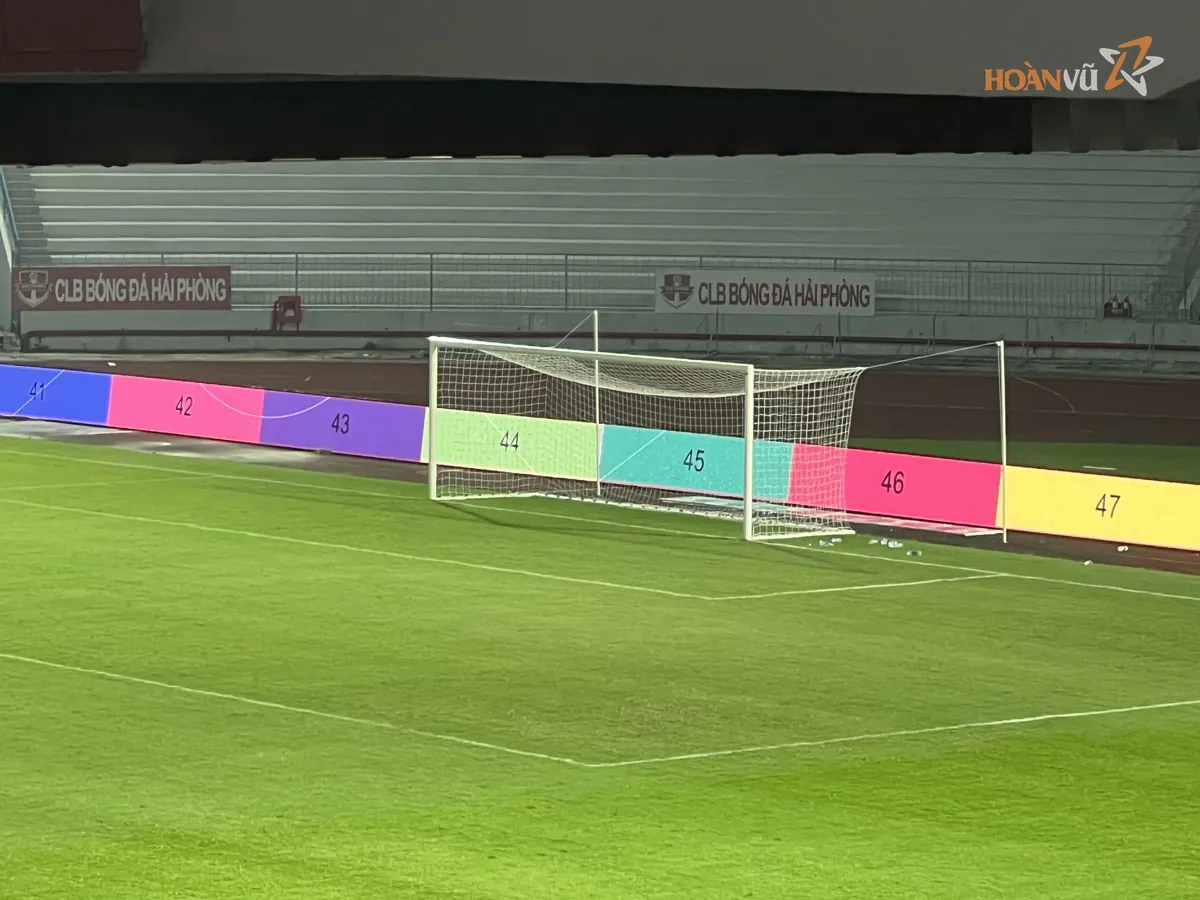
International sponsorship measurement firms describe a frame-level method: seconds of logo presence, logo share of the frame, display quality as full, partial or obstructed, and the context of each appearance. The method works for printed boards too, but only LED adds a play log to reconcile against.
One note on rotation: a measurement firm's own material reports that in European competitions brands often change slots roughly every 30 seconds on the same strip. That is practice in those competitions, not a rule in Vietnam. Actual airtime still comes from the league regulations and the contract.
Three items belong in the contract itself: total airtime per match, number of matches, and the format of the post-match acceptance record.
Where Hoan Vu sits in this chain
Hoan Vu has worked in advertising since 2001 and was incorporated as a joint stock company in 2010. It currently operates perimeter LED at four grounds, Hang Day, Lach Tray, Binh Phuoc and Pleiku, works with six clubs and covers around 84 matches a season. Each match has a technical crew on site, and each match ends with an acceptance record including photos and video. Beyond football, the company builds indoor and outdoor LED screens, billboards and signage, and produces events, live shows and livestreams with a green screen studio.
For more on how rights packages are split, see Football club sponsorship: rights packages and how to measure results. Equipment and operations are covered on the stadium LED solutions page.
Frequently asked questions
Do printed perimeter boards still make sense?
Yes, when the match is not televised, the creative stays fixed all season and the budget needs to stay tight. Low running cost is this format's strength.
Does perimeter LED need its own creative?
Yes. The strip is long and shallow, so type has to be large, detail sparse and contrast high. Reusing a printed board file usually reads poorly on camera.
How is perimeter LED performance measured?
From the per-match play log combined with image data: seconds of presence, share of frame and display quality. Lock that reporting format into the contract.
Conclusion
Printed boards sell space, perimeter LED sells time. The choice comes down to three things: whether the match is televised, whether creative needs to change per match, and what kind of season-end report the brand needs. With ground data and a fixture list, it can be worked out quickly. To review options for this season, leave your details or call the hotline 0964 73 74 73.
Hoan Vu connects brands with clubs, builds packages and reports match by match.